3D and AI news · 18 November 2026Megascans free again, Unity CLI 1.0, GPT-6.2 Astra, Apple FastFrames and MiniMax H3 Image on 8 GB
AI agents moved further into 3D apps this week: Unity's CLI left beta, Silo and SolidCraft added MCP servers and Cascadeur showed Claude animating a whole scene. Quixel made Megascans free again, Apple and Meituan released open video models, and MiniMax H3 Image picked up low-VRAM workflows and character-swap LoRAs. Every story links its source.
The full Megascans library is back on Fab's free shelf, Digital Production reports, after most of it went behind price tags in January 2025. Assets come under the Fab Standard License, which allows commercial projects but not standalone redistribution, and Quixel's updated terms now permit training AI models on Megascans and Megaplants. Anyone who bought Megascans on or after 1 January 2025 gets the money back as Epic account balance by the end of 2026. Quixel has also ended Mixer development, with a final offline build to download.
Why it mattersThousands of scanned surfaces and props for Unreal, Blender or any FBX and glTF app, at no cost.
Unity announced at Unite Tokyo on 17 November that the Unity CLI and the Pipeline package (com.unity.pipeline) are out of beta at version 1.0. An agent can open a project, run Editor commands, build, enter Play mode and read the results. Official plugins exist for Claude Code, Codex, Grok Build and Google Antigravity, and one install command adds Unity's skills to other agents such as GitHub Copilot or OpenCode. Unity promises commands and output stay compatible across 1.x, and says a supported headless Linux Editor in a container is coming.
Why it mattersAgents can now block out levels, fix compile errors and playtest a scene without anyone clicking through the Editor.
Unity Technologies Japan released Atrio, a free URP sample project built with Unity 6.7 Beta. It lights the scene with the new Surface Cache GI, computing indirect light in real time with no lightmaps, and adds STP upscaling, screen-space reflections and GTAO. Unity says the demo runs at full resolution at 60 fps and that the same quality holds on mobile and consoles such as Nintendo Switch 2. Commercial use is allowed under the Asset Store EULA.
Why it mattersA working reference for dynamic global illumination in URP before the feature reaches a stable release.
Unity will pick ten indie teams making games with Unity and give each a $50,000 cash grant plus technical, marketing and industry support on the road to launch. Submissions are open until 18 December.
Why it mattersMoney and help for the last stretch before release, where small teams most often run short.
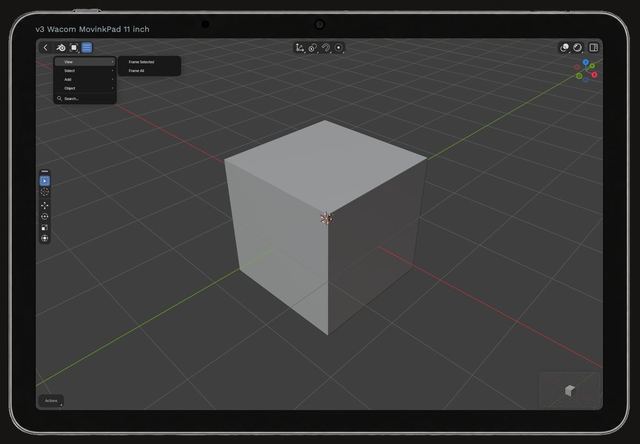
Blender's developers published their plan for tablet versions on Android and iOS, aimed first at high-end Android tablets such as the Wacom MovinkPad Pro and recent M-series iPad Pro or iPad mini models. Touch and pen input mostly works already. Still to come are daily tablet builds, test releases to the app stores, a compact UI and touch tools such as an on-screen keyboard and a modifier wheel. At first the tablet version will need a keyboard and a mouse or trackpad to be fully usable. No release date is given.
Why it mattersFull Blender on a tablet would let artists sculpt, paint and review away from the desk.
The Godot Foundation announced on 17 November that Manus, which makes a general-purpose AI agent, now funds Godot's development as a Platinum sponsor, a tier the foundation prices from 50,000 euros a year. Manus also runs a Game Dev initiative for making games with its agent.
Why it mattersMore steady funding for the free engine, and a sign that AI companies are courting game developers.
TinyLanternDev's Stylized Water adds Gerstner waves, shoreline foam, caustics, reflections, floating objects, waterfalls and underwater effects to Godot 4 on the Forward+ renderer, with six presets controlled from a single StylizedWater node. A free Lite version has a simpler shader, two Gerstner waves, one preset and a small example scene.
Why it mattersGood-looking water for stylized Godot games without writing the shader yourself.
LoadingFX has 18 procedural SDF spinners and 3 loading bars built from materials, with no textures, and a project-wide loading icon that keeps animating while the game thread is blocked by OpenLevel or synchronous loads, by handing off to MoviePlayer. It works in Blueprint-only and C++ projects on Unreal Engine 5.5 to 5.8, ships with an AGENTS.md guide for AI coding agents, and is MIT licensed.
Why it mattersA frozen loading screen looks like a crash; this fixes it without custom engine work.
Max Miles, a longtime Houdini user, released Carnage Grains, an XPBD grain solver for Blender 5.1 and later that handles sand, snow, mud and gore, from loose grains to clumps held together by attraction or glue. Animated objects can push and deform the material, stretching and breaking can be art-directed, and saved simulations can be refined without running them again. It costs $49.99 once with future updates included, and needs 64-bit Windows and an NVIDIA GPU with CUDA.
Why it mattersGranular effects that used to mean a trip to Houdini, now inside Blender.
HairMesh, riel's free Blender port of CataRackta's Stylized HairMesh Creator, turns curves drawn on a head into clean quad hair meshes. Version 1.1.0 (14 November) adds flat ribbon locks and volume branches, tools for X junctions, Split Ends, extruding a curve from either end and a reworked menu and N panel. Version 1.1.1 (16 November) shows the mirrored half live while you edit. It needs Blender 5.1 or later.
Why it mattersStylized anime-style hair as game-ready quads, for free.
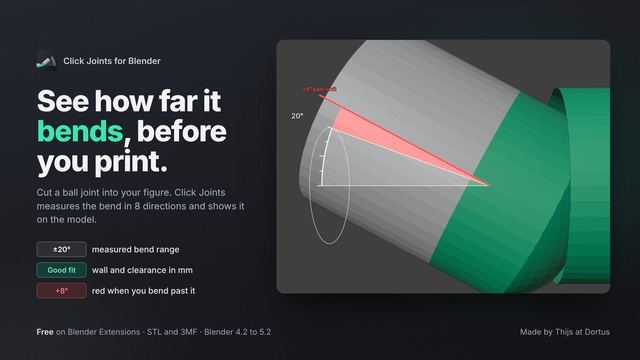
Click Joints cuts ball-and-socket or pin joints into a mesh for 3D printing, with the clearance set in millimetres. For ball joints it measures how far the joint bends in eight directions before the parts collide, marks a collision in red, warns when a wall is too thin and exports each part as STL or 3MF. It is free and open source (GPL-3.0-or-later), tested on Blender 4.2 LTS and 5.2 LTS, and listed on the Blender Extensions platform.
Why it mattersPosable printed figures without trial-and-error prints to find out whether a joint moves.
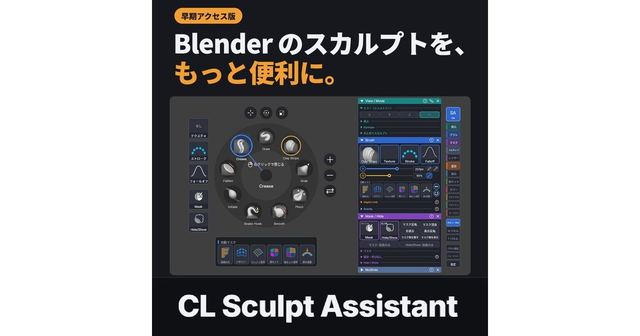
Calappa Lab's add-on adds temporary mask controls, pie menus, movable viewport panels, bend tools, sculpt layers, detail transfer after remeshing and Boolean layers to Sculpt Mode. It is in early access for 800 yen on BOOTH under GPL-3.0-or-later and supports Blender 4.5.2 to 5.2.x; the developer has tested it on Windows only.
Why it mattersFaster sculpting with fewer trips to the menus.
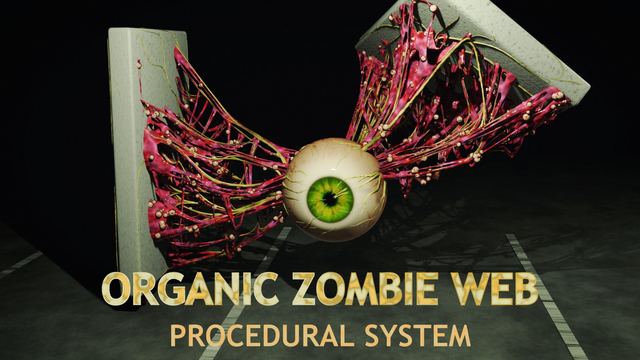
Deepak Kushwaha's procedural system grows thick, vein-covered webs between a surface and a subject, with separate surface-to-subject and web-to-web layers, scattered extras such as small webs, pores or spiders, and its own materials. It needs no simulation and can be realized into an ordinary mesh. It is a low-cost paid asset on Fab, and the seller calls it a first version.
Why it mattersSet dressing for horror and post-apocalyptic scenes in a few clicks.
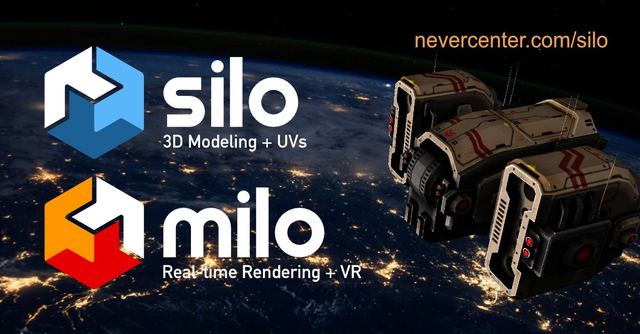
Nevercenter's lightweight sub-D modeller gets its first scripting API, in JavaScript, with more than 100 functions covering primitives, mesh edits, selections, materials, UVs and cameras, plus a built-in Script Editor. A new MCP server lets AI tools such as Claude or ChatGPT drive Silo through that API. The Blender Bridge now works between faces or edge loops of different sizes, and glTF export gets proper PBR materials. A perpetual licence costs $159 with the Milo renderer included; it runs on Windows 10 and later and macOS 12 and later.
Why it mattersOne more modelling app an AI agent can operate directly.
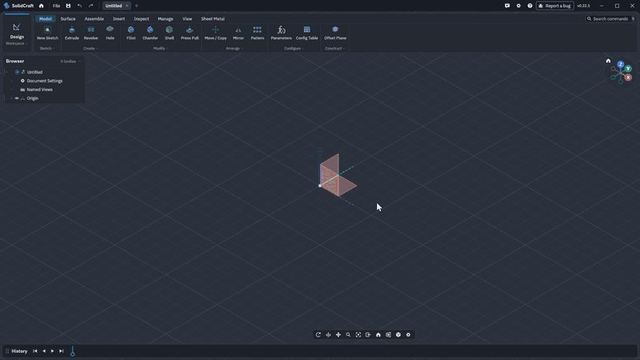
SolidCraft is a parametric 3D CAD application: sketch, constrain, extrude or revolve, with a history timeline that rebuilds when you change an earlier dimension. It is free under MIT or Apache-2.0 for Windows, macOS, Linux, FreeBSD and the browser. Its developer, Brennen Herbruck, told FabScene it reached about 1.5 million GitHub downloads and 16,000 stars in five weeks, with 58 stable releases between 9 October and 12 November. A built-in MCP server and an in-app chat let agents such as Claude Code, Codex or Gemini CLI operate the CAD tools.
Why it mattersA free CAD option for printable parts and product models that AI agents can drive.
KeyShot's product-visualisation renderer gets a beta AI agent that changes a scene from a prompt, for example swapping materials, moving the camera or making an exploded view. It runs in the cloud and uses KeyShot's credits. The release also adds Part Variations for geometric variants, faster caustics and better import from Cinema 4D and Substance 3D Painter. Subscriptions start at $1,299 a year.
Why it mattersProduct shots with fewer manual scene edits.
Sisir, a free standalone guide-based groomer, now makes card-based hair for games and real-time work as well as strands, and a new Texture module bakes colour and ambient occlusion per tile. New open-source (MIT) plugins import Sisir scenes into Blender 4.2+, Maya 2022+ and 3ds Max 2022+ and send hair guides back.
Why it mattersGame-ready hair cards from a free tool, straight into the main DCC apps.
Theory Accelerated's GPU sparse volumetric fluid solver for Houdini now outputs colour and auxiliary data from combustion, grows its voxel count dynamically to reduce artifacts and stores sparse data in a hash table instead of an octree. Its makers say the solver is about 1.11x faster overall and advection about 1.8x faster.
Why it mattersQuicker iterations on explosions and smoke for cinematics and VFX.
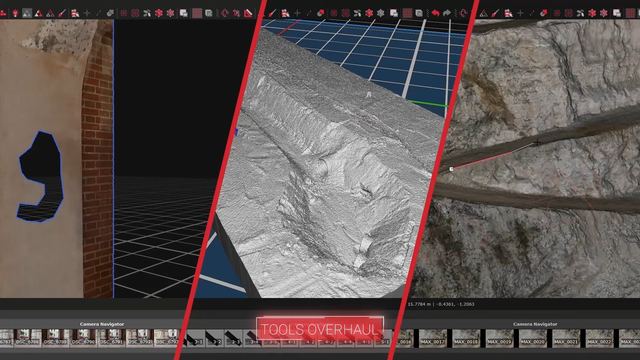
3Dflow's photogrammetry software speeds up Structure-from-Motion and Multi-View Stereo, revises its hole-filling and Volume from Projection tools and extracts sections and breaklines at higher quality. A separate app, 3DF Jimbo, trains segmentation models on your own data and is offered to selected customers. Zephyr has a free edition for personal use (up to 50 photos per project); Lite costs 199 euros plus VAT, perpetual. Windows only.
Why it mattersFaster scans to meshes, with a free tier to start on.
Jens Kafitz's tool suite for Foundry's Mari adds more than 200 tools, including importing and editing .sbsar materials (this needs Substance 3D Designer or the Substance Automation Toolkit), non-destructive text and a rewritten Selection Fill node. It works with Mari 8.x only, older packs are included with a purchase, and prices dropped slightly with the move to a new store.
Why it mattersSubstance materials inside the texture painting tool most VFX studios use.
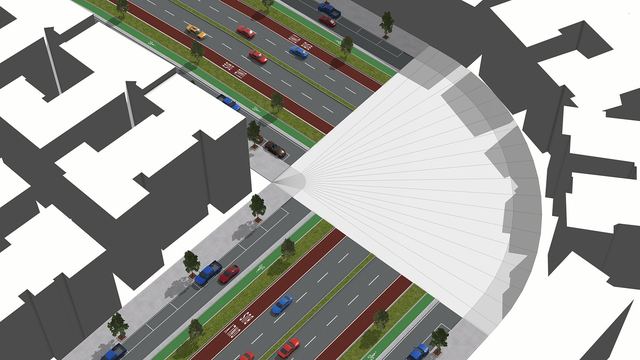
Esri's procedural city generator now creates lanes where joined street segments have matching lane counts, adds shading and facade elements to the Visual CGA Editor, lets the Python API work with several CityEngine instances at once, adds command-line options for unattended batch jobs and improves glTF, OBJ and Collada export.
Why it mattersQuicker city layouts for previs, games and archviz.
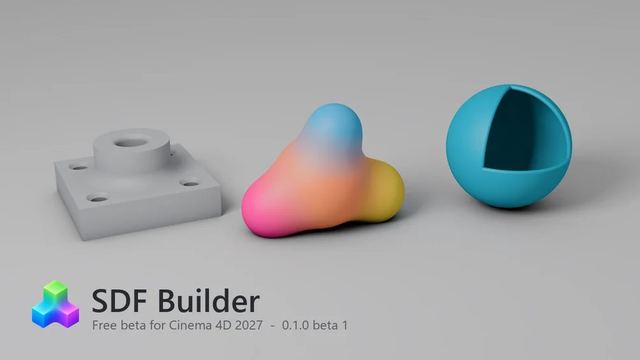
A new Cinema 4D 2027 plugin works like the Volume Builder but keeps most shapes as exact formulas, so edges stay crisp and smooth, fillet and chamfer blends stay fully procedural. Its developer released a free beta for Windows and macOS on a pay-what-you-want basis.
Why it mattersClean procedural hard-surface blends in Cinema 4D without voxel softness.
The 960 g scanner has its own CPU, NPU and 6-inch screen, six laser and structured-light modes, single-frame accuracy of up to 0.02 mm and up to 120 fps when paired with a PC with a GPU. Connected to a PC it exports Gaussian splats at 1:1 scale, and its Revo Agents software converts a selected part of a scan into CAD geometry from a text command. A Kickstarter campaign started on 18 November, with early pledges from $1,425.
Why it mattersOne device that captures both splats for visuals and meshes or CAD for production.
Ink Studio, from Shapeshift Labs, sculpts signed-distance solids and bakes them into pixel-art Gaussian splats, with palettes and dithering, animation clips and state machines, particles, and physics such as breaking, rubble, cloth, hair and rope. It is a Node.js library and command-line renderer (MIT), not a finished editor. cobanov's pixelart-gaussiansplat renders pixel-art splats in the browser with three.js and Spark and converts glTF or GLB models, rigged ones included, into splat scenes (MIT).
Why it mattersA retro look with real 3D depth, built from code instead of hand-placed sprites.
Paint over a floater, a sign or a hole in a scan and Splat Repair rebuilds the surface under the stroke. Fast Fill fits the surrounding surface on the CPU in about 0.3 to 1.5 seconds on a 550,000-splat scan; Deep Fill uses the LaMa inpainting model on an NVIDIA GPU (about 20 seconds on an RTX 4090), and an optional bridge hands the view to Photoshop's fill tools. It reads PLY, .splat and SPZ, runs on Windows, is Apache 2.0, and its author calls it an early release.
Why it mattersClean-up for scanned splats, which had few editing tools until now.
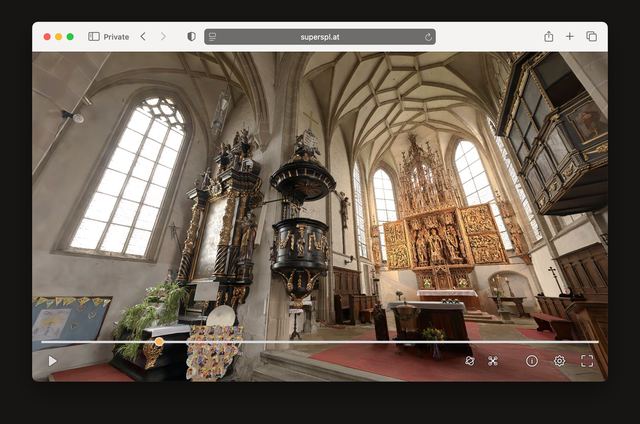
Splats trained with an anti-aliasing filter, such as Postshot exports, Mip-Splatting or Brush's mip mode, used to look washed out in the SuperSplat web viewer unless you added ?aa to the URL. Version 1.43 reads the training mode from PLY, SOG, SPZ and streamed LOD files and compensates per splat, so both kinds can sit in one view. Classic scenes also show thin detail more fully, because the renderer now uses the same low-pass filter that 3DGS trains with.
Why it mattersShared splats look the way they did in the trainer, with no URL tricks.
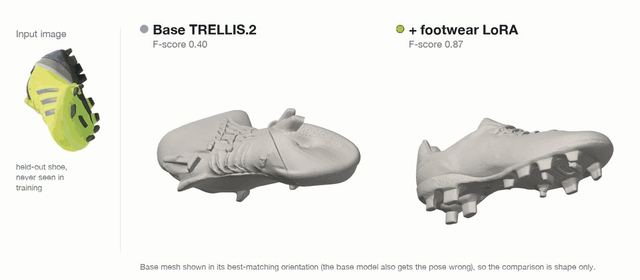
A Hugging Face blog post (12 November) walks through LoRA fine-tuning of two of TRELLIS.2's three stages, sparse structure and shape, on 179 shoes from Google Scanned Objects, adding about 9.3M trainable parameters. The two runs took 7.2 and 3.6 hours on one A100 80GB, and the authors report the F-score on held-out shoes rising from 0.276 to 0.803. Code, containers, the dataset and the trained adapters are public.
Why it mattersA recipe for teaching an image-to-3D model the kind of objects you make.
Budget3D released two Apache-2.0 image-to-3D models that output 3D Gaussian splats: Budget3D-Idol (50 steps) and Budget3D-Idol-Turbo (5 steps), built on speridlabs' Idol models, with code on GitHub. The project calls them unofficial community implementations, and a tech report is listed as coming soon.
Why it mattersAnother free route from a single image to a splat model.
Give the new Segmentation API a Gaussian splat world and it divides the scene into labelled objects, each exportable as its own mesh. SpAItial says this is the starting point for physics in its generated worlds. It is coming soon to the SpAItial API, with early access by request.
Why it mattersGenerated splat worlds become editable scenes instead of one frozen capture.
Meshy launched the Z-Axis Awards with six tracks: Gaming, 3D Printing, Film and Visuals, Tabletop, XR and Robotics. Track awards go up to $10,000 each, alongside Build in Public rewards and Best Use awards. Entry is free, the track awards accept work made with any tools, and work must be finished on or after 1 February 2026. Submissions close on 24 January 2027, winners are announced on 17 February and the gala is in March during GDC.
Why it mattersPrize money for 3D creators, whichever tools they use.
Tripo's new global creator program backs selected game, animation, interactive and creative-tool projects with access to its AI 3D tools, funding and promotion. Applications are open through Tripo Studio's Creator Hub; Tripo has not published funding amounts.
Why it mattersA possible source of backing for small studios that rely on AI-generated assets.
Apple published FastFrames-S (1.3B) and FastFrames-L (14B) on Hugging Face: autoregressive two-step video diffusion models that make 832x480 clips of 81 frames at 16 fps. Apple lists 35.4 ms in total for FastFrames-S on one GPU with a full cache. The code is on GitHub under Apple's sample code licence and needs Linux and an NVIDIA GPU with a CUDA 12.8 driver; the parts based on LingBot-World v2 are CC BY-NC-SA 4.0.
Why it mattersNear-instant video generation is what live previews and interactive tools need.
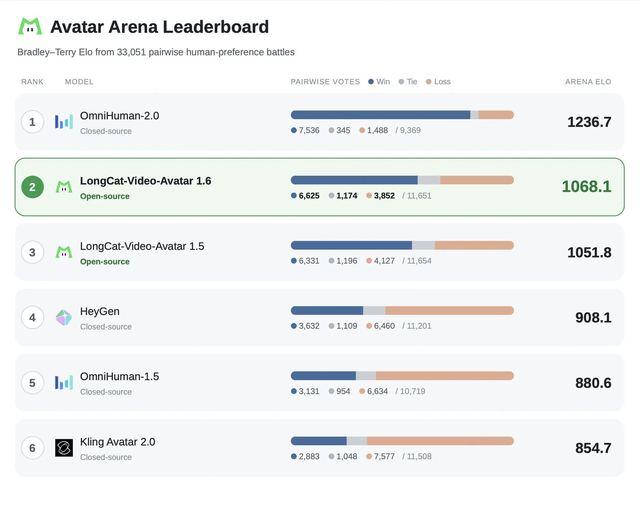
Meituan's model turns a photo plus audio, or text plus audio, into a talking or singing person, with one or several speakers. Version 1.6 improves lip sync, facial and body motion and identity consistency over videos longer than ten minutes, and speeds up inference with an 8-step mix of two distilled LoRAs. The weights are MIT licensed; the example commands use two GPUs, with optional FP8 or INT8 quantisation.
Why it mattersLong presenter and explainer videos from a single photo, with weights you can run yourself.
Given a start image, a prompt, hand motion and camera poses, LynnReal-Hand generates video of hands handling objects. The Base model renders at 1344x768; the causal Fast model samples in three steps and, according to the paper, reaches about 18 fps at 540p on one H200 with about 35 GiB of peak memory. The weights are on Hugging Face under the MiniMax H3 Community License.
Why it mattersHand-object shots are among the hardest for video models, and this one takes the hand motion as input.
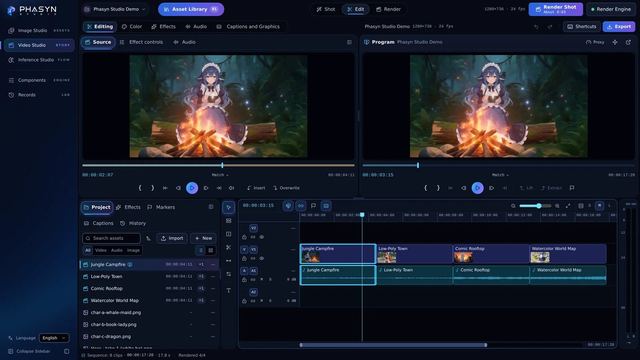
Phasyn Studio is an open-source (Apache 2.0) studio that generates short videos with sound using MiniMax H3 and still images with Qwen-Image 2.1, with a timeline editor for transitions, text, captions and music. It needs Linux, an NVIDIA GPU and a CUDA 13.0 driver, and was tested on an RTX 3060, an RTX 5080 and a DGX Spark. The model licences apply: the project notes that MiniMax H3 videos may not be used or shown in the EU, UK, South Korea or US, and that Qwen-Image 2.1 is non-commercial.
Why it mattersA complete local video app with no per-clip credits, if the licences fit your use.
SwitchX changes the lighting or background of existing footage while keeping the subject intact. Version 3.0 is rebuilt on MiniMax H3 and adds moving backgrounds, up to four reference images per job, better camera tracking and closer prompt control. It runs in Beeble's web app on credits; Creator plans start at $19 a month.
Why it mattersRelight or relocate a filmed shot without a reshoot.
From 8 am EST on 19 November to 8 am EST on 20 November, Envato's AI Video tool gives unlimited MiniMax H3 generations to subscribers and to free account holders, under a fair-use policy.
Why it mattersA free day to test H3 at volume before paying for a plan or setting it up locally.
Adobe's After Effects 27.0 brings a dockable AI Assistant that renames and organises layers and comps, edits text and shape layers, writes and debugs expressions, adjusts keyframe interpolation and generates footage with Firefly and partner models, asking for approval before it acts by default. Other additions include animated layers as 3D material sources, Substance 3D materials on 3D text and shapes, editable Illustrator text, an Adobe Stock panel and a Contour Paint effect. Most AI actions use generative credits.
Why it mattersRoutine project housekeeping and expression writing handed to an assistant inside After Effects.
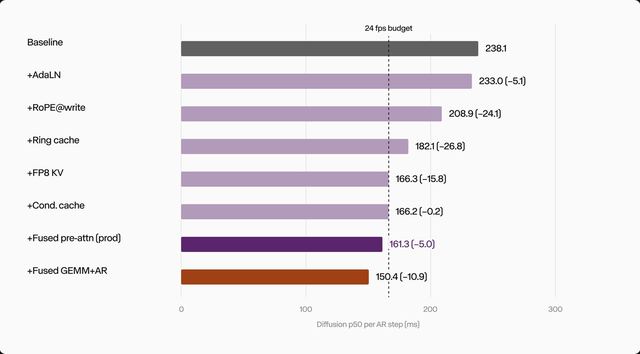
In a research post, Runway describes how Runway Characters, a roughly 57B-parameter autoregressive video model that turns one image into a live character at 704x1088, went from eight H100s per session to four while holding 24 fps. The savings came from moving cache upkeep to write time, a fused FP8 matrix-multiply and all-reduce kernel, and giving the decoder its own GPU.
Why it mattersCheaper real-time video is what makes live AI characters affordable to offer.
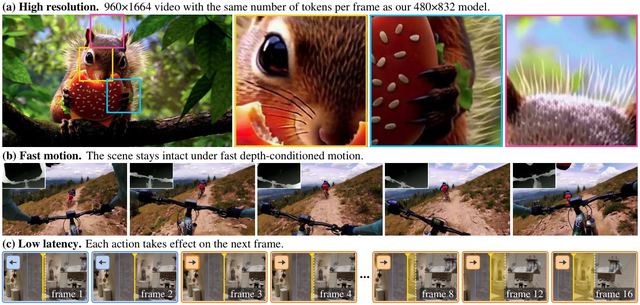
PixVid (arXiv 2611.17336) swaps the VAE decoder of Wan2.1-14B for a convolutional pixel head so the model generates one frame at a time in pixel space; its authors say this doubles resolution for the same token count and lets the model answer a control input on the next frame. MPEG-Diffusion, from researchers at Roblox and UT Austin, renders the important region of a video at full resolution and the rest at low resolution, and reports 4.8x faster denoising on Wan2.1 14B. Neither paper links code yet.
Why it mattersBoth point to cheaper, more responsive video models for interactive use.
The Cascadeur team showed Claude making an Assassin's Creed-style animation inside Cascadeur: it set up the scene, built a castle model, made textures with ChatGPT and animated the character with keyframes, Inbetweening, AutoPosing and AutoPhysics. The team says this comes with the new version of Cascadeur's MCP server.
Why it mattersPhysics-aware character animation driven by an AI agent, not only keyframed by hand.
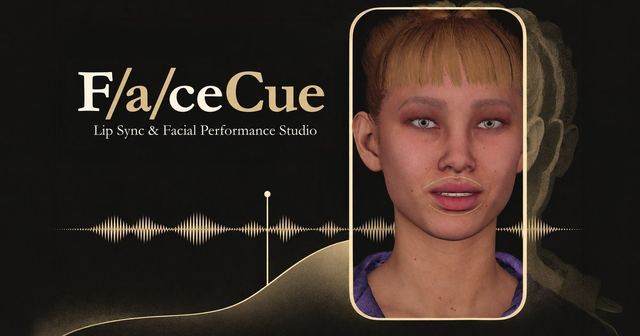
Christos Nasioutzikis's FaceCue (Firecrest Roost) generates lip, eye, expression, head and breathing motion for a mapped character rig from dialogue audio, with an optional transcript to improve alignment. Cues are baked in the Windows editor and play at runtime. It supports Unity 2021.3 to 6.6 and costs 129 euros, currently 65 euros, on the Asset Store.
Why it mattersTalking characters in Unity without hand-keying every line.
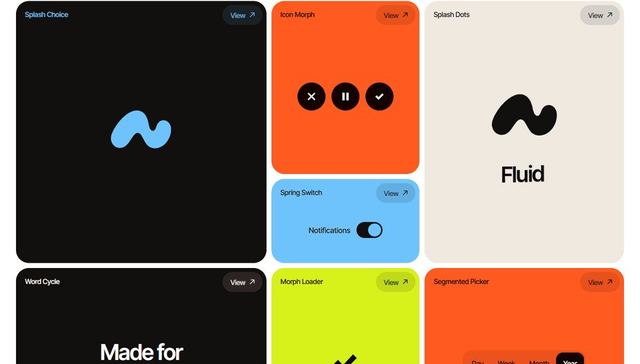
Fluid animates brand pieces such as morphing logos, buttons, toggles, splash openings and mascot characters with spring physics, styled with your own logo, colours and font. Its command-line tool records any page frame by frame to MP4 at 60 fps in story, post, square or wide formats, and seven agent skills let a coding agent set up the brand, pick components and record videos. MIT licensed.
Why it mattersBranded motion graphics for sites and social clips, written as code an agent can edit.
Three new ComfyUI workflows run MiniMax H3 Image at its full 16 MP output on 8, 12 or 16 GB cards, using an INT8 diffusion model and an NVFP4 text encoder, with tiled VAE decoding on the smaller cards. No custom nodes are needed (tested on ComfyUI 0.45.3). On an RTX 5070 Ti the author measured about 60 to 66 seconds for a 16 MP text-to-image; the 8 GB setup needs 24 GB of system RAM (32 GB is safer) and about 38 GB of disk.
Why it mattersThe top open image model on mid-range graphics cards.
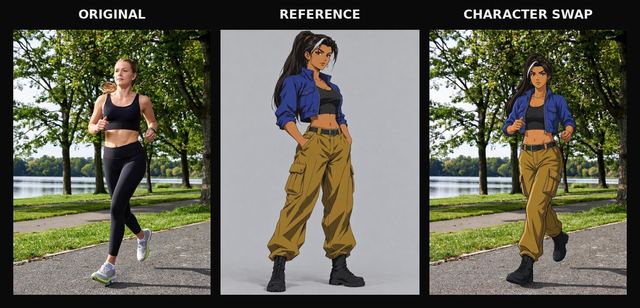
MiniMax-H3-Image-Character-Swap fuses akatz-ai's character-swap LoRA into H3 Image (also offered as a 155 MB adapter): picture 1 is the scene, picture 2 the character, and the background, lighting and pose are kept. It needs ComfyUI 0.45.0 or later. Separately, Alissonerdx's H3 Image LoRA v0.1 swaps up to three people in one still: you mark each person red, blue or green in the BFS Picker node and bind each colour to a reference picture. Both are experimental and can drift on hard poses or small faces, and the H3 Image licence limits use in some regions and above $1M revenue.
Why it mattersRecasting a still with your own characters, locally.
Avatar 6 turns a portrait plus speech audio, or a stock presenter or your own authorised avatar plus a script, into an on-camera performance with lip sync, gestures, expression and posture in one take. A motion prompt of up to 1,200 characters directs the performance. The current ComfyUI workflow does not accept reference videos of realistic people. It is a paid partner node, and Comfy's page opens both workflows in Comfy Cloud.
Why it mattersPresenter shots inside the same graph as the rest of a video workflow.
This open workflow wraps MiniMax H3 model loading, the Turbo LoRA, sampling, resolution and audio decoding in one subgraph with a single control panel. Connect a first and last frame, only a first frame, or no image for the three modes; it outputs 24 fps video with sound. It needs a ComfyUI build with H3 and subgraph support plus the ComfyUI-MiniMax-H3-Turbo node pack.
Why it mattersA tidy starting graph for local H3 video.
A community workflow moves the motion from a video onto any character picture, using an INT8 ConvRot build of the Viggle model or a LoRA that puts MiniMax H3 Ref2V into Viggle mode. A Qwen VL step writes the prompt from the video, and RelayVSR upscales the 480p or 720p result. Its author reports about 20 minutes for a 5-second 480p clip.
Why it mattersCharacter motion transfer on an entry-level graphics card.
This MIT-licensed extension snaps a node, as you drag it, to where its wires run horizontal and to other nodes' edges, adds align and distribute buttons to the selection toolbox and lets you resize groups from any corner. It works with the classic canvas and Nodes 2.0 and installs from ComfyUI Manager.
GPT-6.2 Astra is OpenAI's model for hard professional work and Sol its efficient everyday model. Both are in ChatGPT Work and Codex for Plus, Pro, Enterprise and Edu users, and in the API. OpenAI says Astra beats GPT-6 Astra at less than a third of the cost per task and makes better-looking websites, slides and 3D designs. SiliconANGLE reports API prices of $8 per million input tokens and $40 per million output tokens for Astra (20% below GPT-6 Astra) and $2 and $10 for Sol. Ethan Mollick, who tested Astra before launch, found it uneven and harder to steer, but said it delivered an ambitious Blender and Unity project.
Why it mattersA cheaper top-tier model for agents that build 3D scenes, games and sites.
Kling says Image 4.0 brings native 8K generation, more realistic detail, better text rendering, batch creation and consistent image sets. It is available in Kling's own app and on partner platforms including Higgsfield, fal, Runware and each::labs.
Why it mattersPrint-size images and consistent sets for storyboards and product shots.
Artificial Analysis ranks MiniMax H3 Image the best open-weights model on both its image editing and text-to-image arenas (v2.1). Among all models it places 13th for editing and 25th for text to image; H3 Image Highspeed, a faster API-only version, ranks 14th and 24th.
Why it mattersAn independent check that the open model holds up against closed ones.
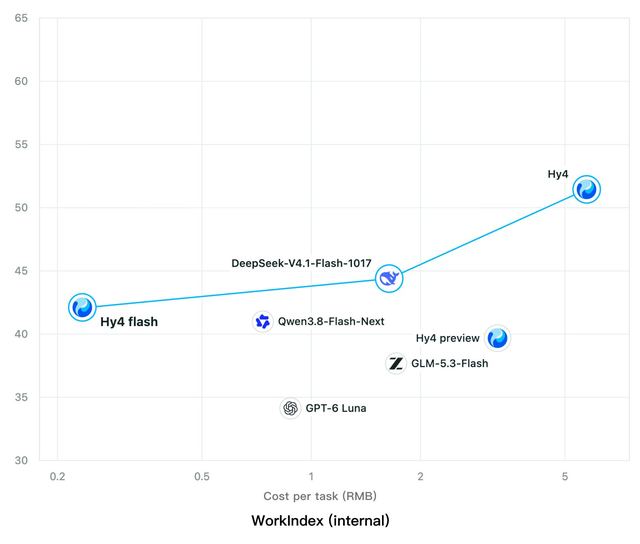
Hy4 flash is a mixture-of-experts model with about 220B total parameters and about 12B active per token, a 1M-token context and text plus image input. Tencent released the instruct model, an FP8 version and the base model under the Tencent Hy License, and GGUF quantisations are available. Tencent reports more than 150 tokens per second and a cost per task about one twentieth of Hy4's. Its reference setup uses eight GPUs.
Why it mattersA large open model for long agent sessions, if you have the hardware or a host.
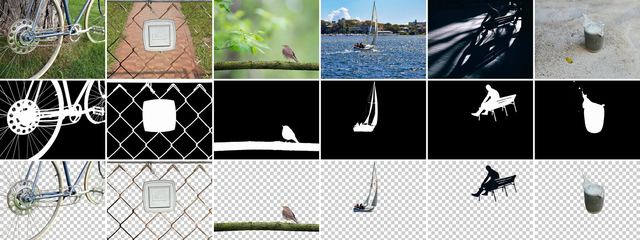
RMBG 3.0 is Bria's third background-removal model, fine-tuned from the 8B Fibo 2.0 and distilled to 4 steps, and it outputs a soft 8-bit alpha matte instead of a hard mask. Bria reports it ranks first on hard cases such as hair, fur and motion blur, and notes it still loses to Photoroom on transparent objects. The open weights are CC BY-NC 4.0 (non-commercial) and need about 32 GB of VRAM; commercial use goes through Bria's API, fal or ComfyUI's partner node.
Why it mattersClean cutouts of hair and fur for compositing.
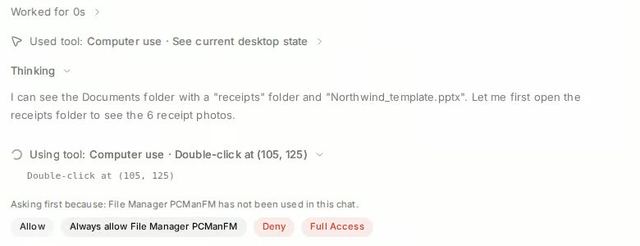
Unsloth v0.1.918-beta lets local vision models (GGUF, safetensors or MLX) and connected providers see the screen and use the mouse and keyboard on macOS, Windows and Linux. It is off by default and asks for approval before the first action and when switching apps. The MCP menu now connects Unreal Engine, Unity, Godot and Roblox alongside Blender. The release also adds GGUF, FP8 and INT8 support and LoRA training for MiniMax H3 Image.
Why it mattersLocal models that can operate creative apps, with no cloud account.
The free local LLM runner can now pair an AMD Strix Halo or Gorgon Halo APU (on ROCm) with an NVIDIA card (on CUDA) under Linux, sharing one copy of the model in system memory. On first start it benchmarks both setups and keeps the mixed one only if it is more than 3% faster. Its developer reports GLM-5.3-Flash prefill rising from 293 to 901 tokens per second at 32K tokens.
Why it mattersMore speed from hardware you already own for local assistants.
Make videos with these toolsOur workflows turn Blender, Unreal, ComfyUI and AI video into finished Shorts, explainers and reels. Claude sets them up for you.