Runway explains how it runs its 57B real-time video model on half the GPUs
Runway says it now runs its 57-billion-parameter live character model on four H100 chips per session, down from eight, at 24 frames per second.
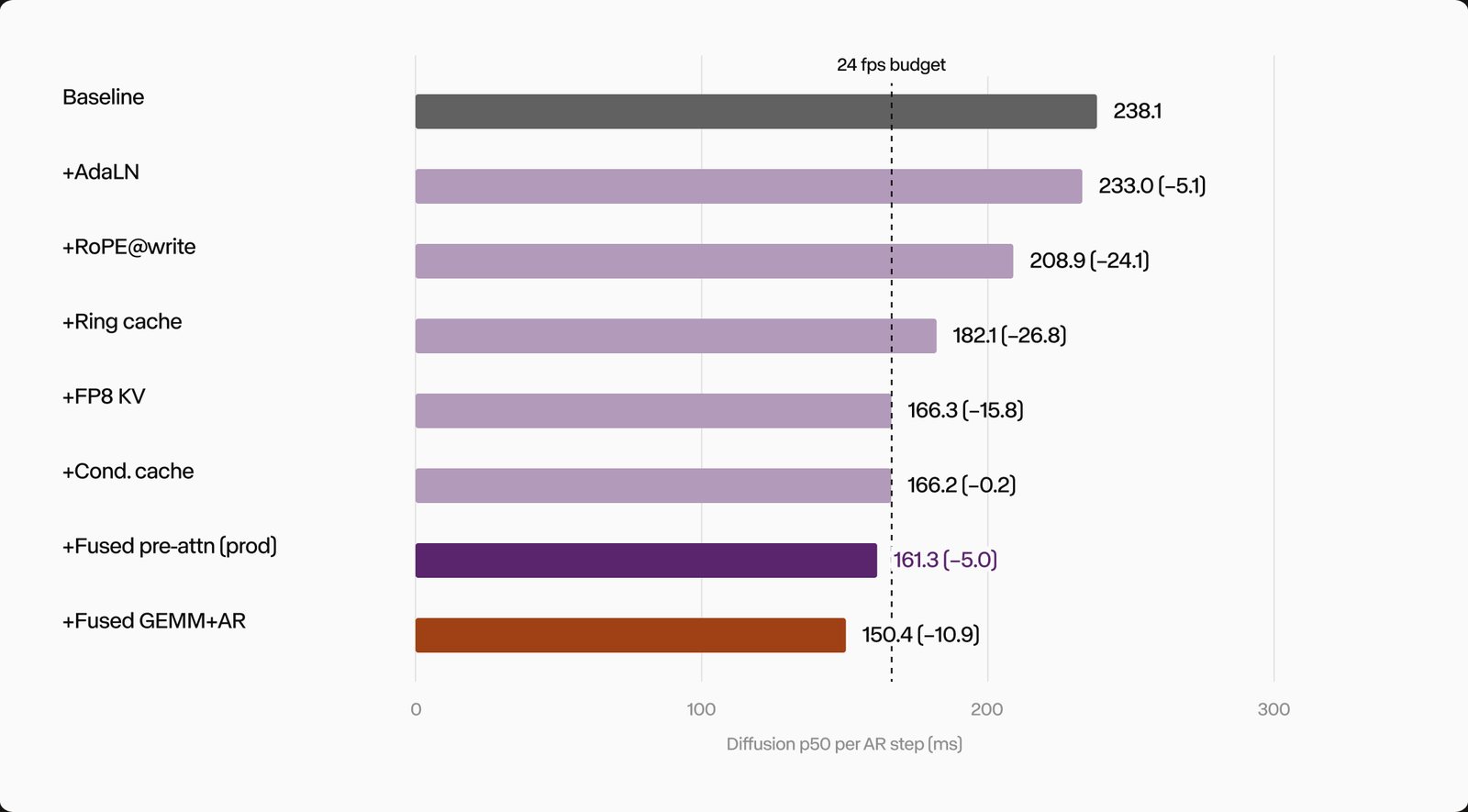
In a research post, Runway describes how Runway Characters, a roughly 57B-parameter autoregressive video model that turns one image into a live character at 704x1088, went from eight H100s per session to four while holding 24 fps. The savings came from moving cache upkeep to write time, a fused FP8 matrix-multiply and all-reduce kernel, and giving the decoder its own GPU.
Why it mattersCheaper real-time video is what makes live AI characters affordable to offer.
What is new
Runway, the AI video company, has published a research post on how it serves Runway Characters. The product turns one image into a live character that a user can talk to. The model behind it has roughly 57 billion parameters. It is an autoregressive video diffusion transformer, which means it writes video a few frames at a time, with each new chunk building on the one before.
Each session serves one user. At launch a session ran on eight H100 chips. Runway says one session now runs in real time on four H100 chips, holding 24 frames per second.
How it works
Runway says three changes did most of the work. The first moved cache upkeep to write time. The model keeps a cache of earlier frames. The original code reprocessed most of that cache at every step and used about 29 percent of GPU time. Now each frame is prepared once, as it enters the cache, and stored in a ring buffer. That cut the cost from 69.7 ms to 6.2 ms per step.
Three further changes are listed below. FP8 is a number format that uses less memory and runs faster.
- A fused FP8 kernel joins the matrix multiply and the step that combines results from several chips. It hides 54 to 68 percent of that waiting time.
- The video decoder runs on its own chip, so it can decode one chunk while the next is being generated.
- On B200 chips, sharing a chip between decoding and generation hit the power limit and slowed generation, so the decoder has its own chip there too.
Results and limits
Over seven weeks of telemetry, the worker averaged above 23.5 frames per second in 99.5 percent of sessions lasting at least one second. The median conversational turn, from the end of the user's speech to the character's voice, took 2.13 seconds.
The article does not give a price or a release date for Characters. On eight H100 chips the decoder would cap the step at about 31 frames per second, so more chips alone would not help.