Hugging Face guide: fine-tune TRELLIS.2 with LoRA on your own 3D category
A Hugging Face guide shows how to add LoRA adapters to TRELLIS.2 so it learns a new kind of object, using 179 training shoes.
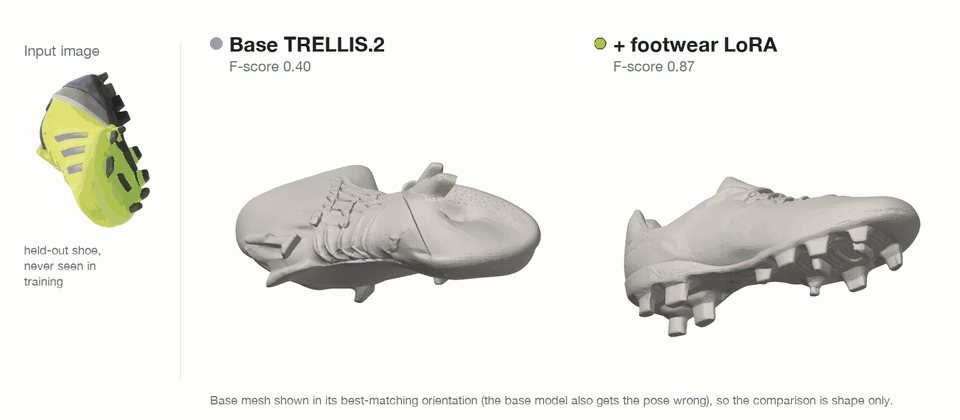
A Hugging Face blog post (12 November) walks through LoRA fine-tuning of two of TRELLIS.2's three stages, sparse structure and shape, on 179 shoes from Google Scanned Objects, adding about 9.3M trainable parameters. The two runs took 7.2 and 3.6 hours on one A100 80GB, and the authors report the F-score on held-out shoes rising from 0.276 to 0.803. Code, containers, the dataset and the trained adapters are public.
Why it mattersA recipe for teaching an image-to-3D model the kind of objects you make.
What the guide covers
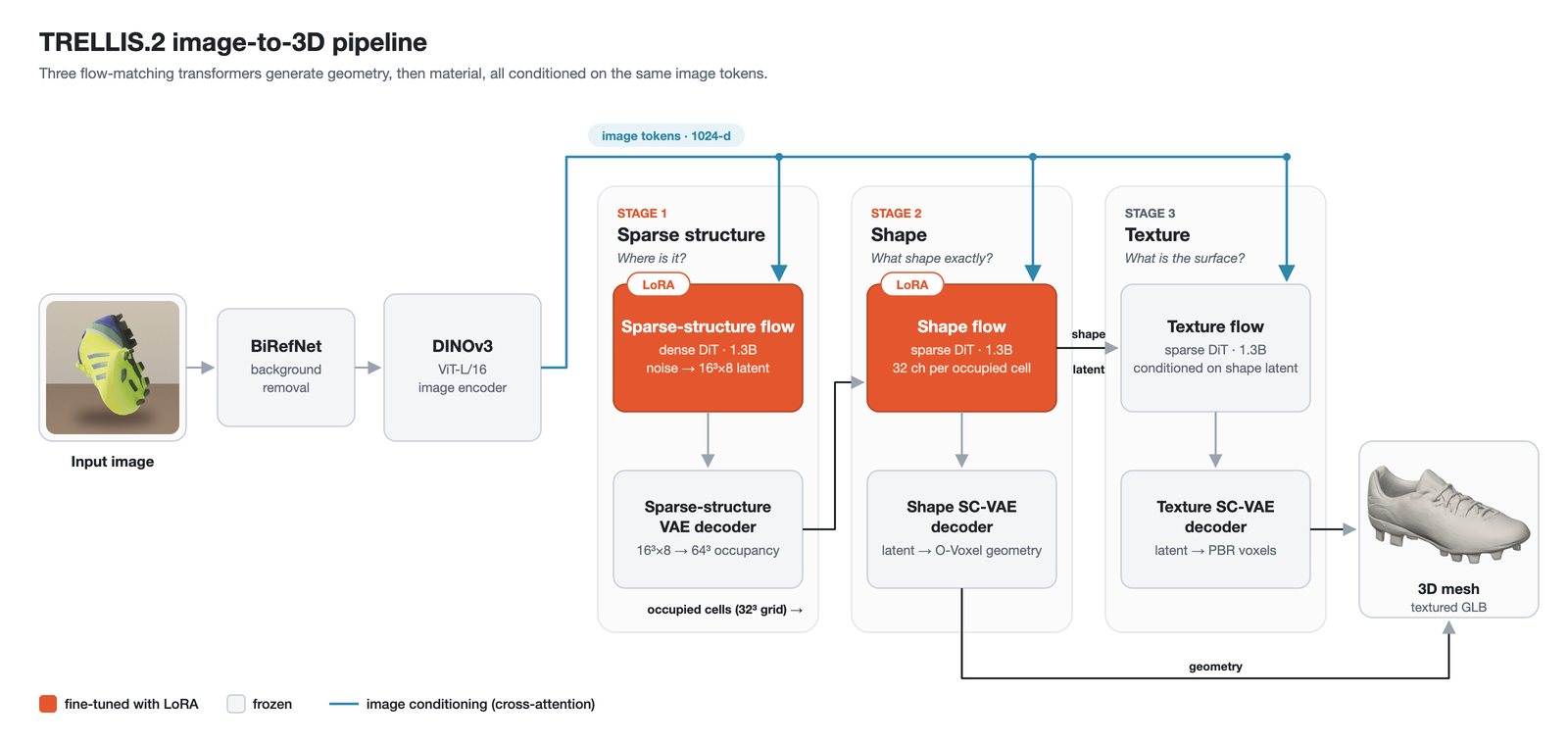
TRELLIS.2 turns one photo into a textured 3D mesh in three stages. The guide adds LoRA adapters, which are small add-on layers that teach a model a new kind of object, to the first two stages. Stage one works out where the object sits in space. Stage two works out its exact shape. The texture stage stays frozen, because the training images have baked-in lighting and no separate material maps.
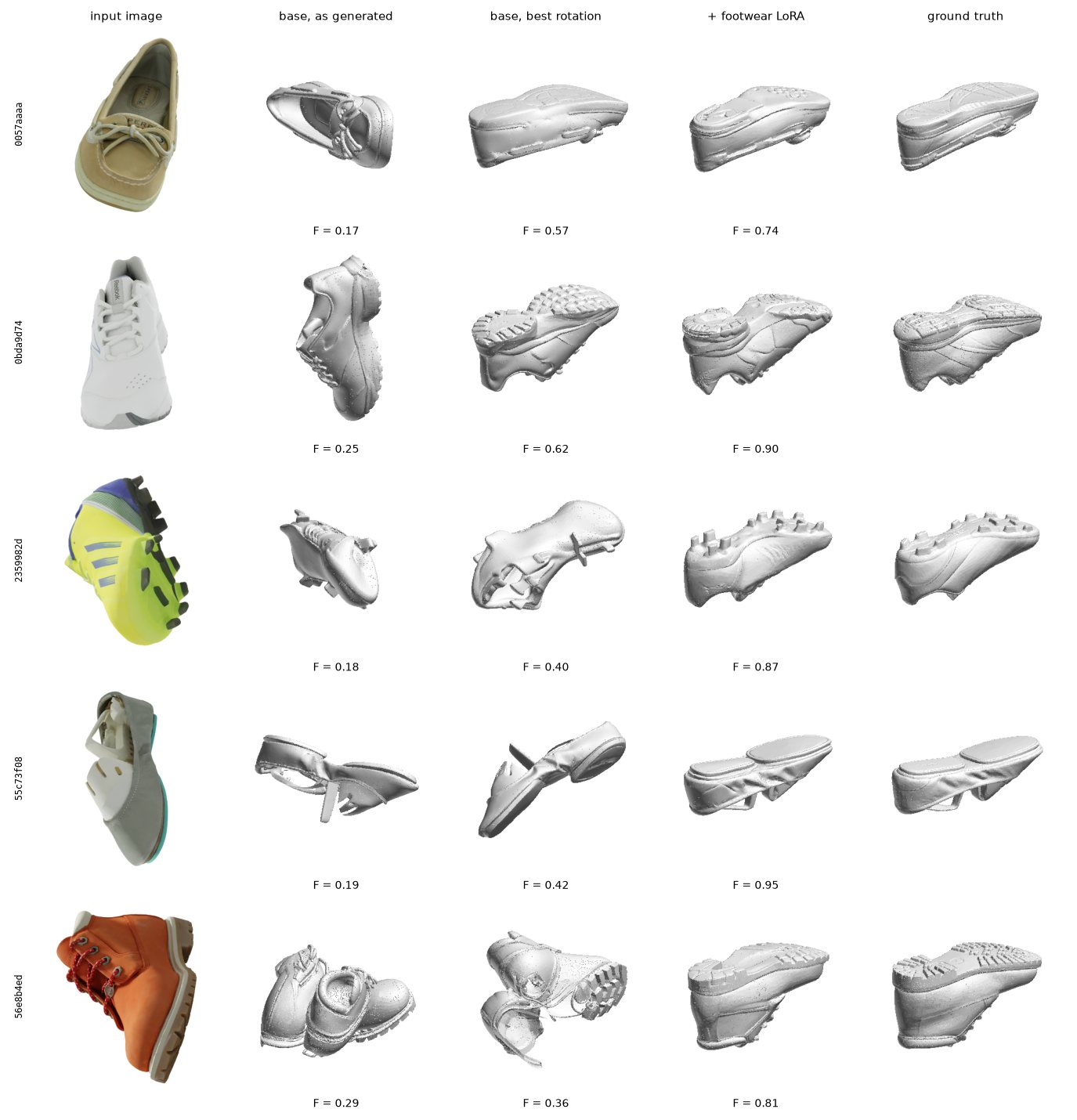
The training set is 179 shoes from Google Scanned Objects, a public library of scanned products. Nine more shoes were held back for testing. Each object was rendered from 16 views in Blender, and each training sample used one random view as its input picture.
Training and results
The guide gives these numbers for the two adapter sets:
- Stage one adapters: rank 8, placed in the attention and MLP layers, trained for 7.2 hours on one A100 80 GB
- Stage two adapters: rank 16, placed in the attention layers, trained for 3.6 hours on one A100 80 GB
- About 9.3 million trainable parameters across both sets
- Mean F-score on the nine held-out shoes rose from 0.276 to 0.803
- Chamfer distance fell from 0.174 to 0.033, and normal consistency rose from 0.530 to 0.804
Limits
The F-score measures how well the surfaces match, from 0 to 1, where higher is better. The authors note that training loss does not show geometry quality, so the held-out meshes were used to check results. The test covers only nine objects. The DINOv3 image model used in the pipeline is gated, so users need access approval first. A reader comment on the page questions how new the work is, because it uses the trainer from the TRELLIS.2 repository.
What is public
The adapters, a preprocessed copy of the dataset, the source dataset, the code and two container images are all public. The authors plan to test the same choices on other 3D generation models, and they mention Gaussian splat and world-generation models as a later step that may need different methods.