Spirula Studio: a free tool for Gaussian splats and textured meshes from photos or video
Spirula Studio is a free, open-source app that trains 3D Gaussian splats and textured meshes from photos, video or 360-degree footage.
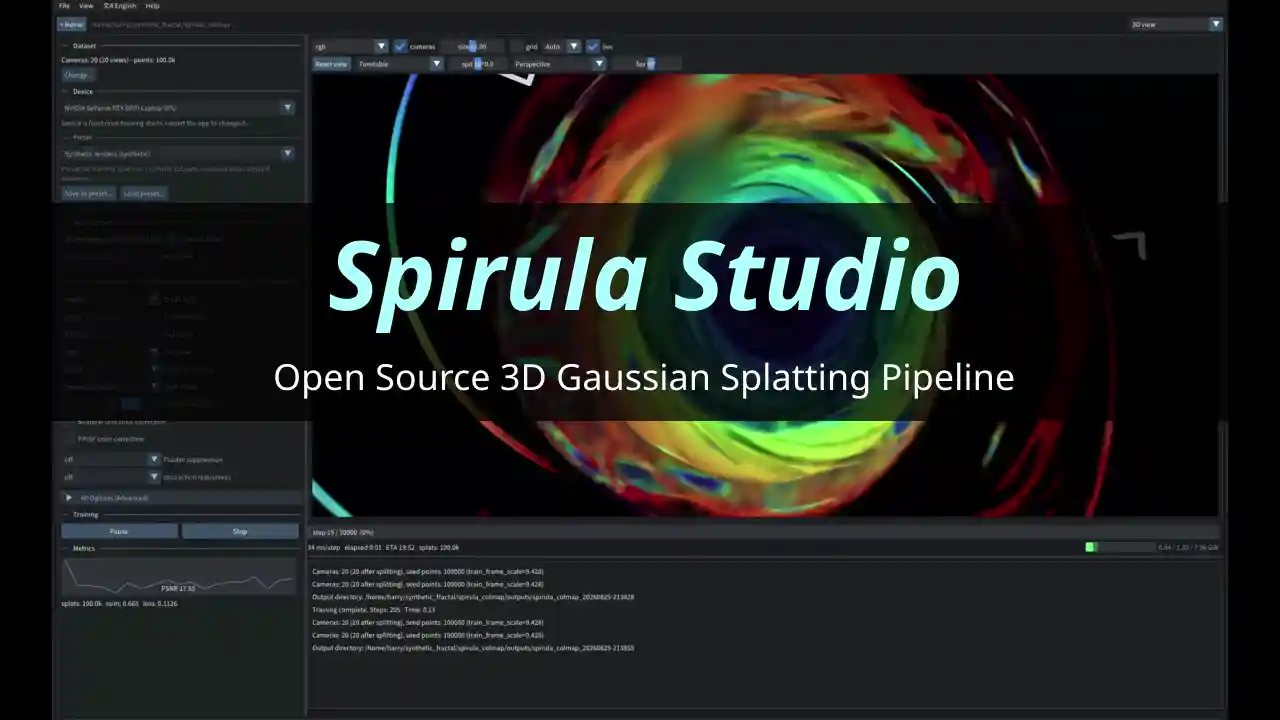
Spirula Studio builds 3D Gaussian splat models or textured meshes from photos and video, runs on a range of GPUs and accepts 360-degree camera footage.
Why it mattersA free capture route to feed the new splat support in Blender and Unreal.
What it does
Spirula Studio starts from photos or video and works out where each camera was, using structure from motion. It can then use AI masking to leave out parts of the images that are not needed, train a 3D Gaussian splat (a scene built from many small coloured blobs), and make a textured mesh from the trained splat. Video is split into frames first. It can also edit splats and meshes, and export rendered images and video.
The maker's README says the app runs as one self-contained binary, with no Python, PyTorch or separate COLMAP install. It accepts 360-degree and fisheye cameras, and equirectangular datasets, without converting them to flat images first.
- GPU: Vulkan is recommended and works on NVIDIA, AMD, Intel and Apple Silicon. CUDA is a legacy option for most NVIDIA cards on Windows and Linux
- Memory: the maker says 8 GB of VRAM can train up to 10 million SH3 Gaussians
- Interface: GUI and command line, in 13 languages
- Remote use: the command line can serve a viewer over HTTP, which can be forwarded over SSH
Limits and notes
The AI masking needs a SAM checkpoint, which is a model file. The GUI downloads it on first use, after showing the terms. Checkpoints are not bundled. SAM 3 is under Meta's own licence. The export file formats are not named in the README or in the review we read. A review on 3DnChu, a Japanese tech site, found the dataset preparation fast, and the training slower than Polycam's in its test. The README says the project is maintained almost entirely by one person.